
Creativity is Not Chaos
Estimated reading time: 7 minutes
Why the most creative minds build systems to protect their imagination.
Over the past few years, this has become impossible to ignore. Running creative thinking workshops, leading teams as a creative director, and maintaining parallel practices in photography and painting, I’ve seen how often ideas don’t fail from lack of brilliance. They fail from lack of structure. The difference between imagination and output is rarely talent. It is support.
For as long as I can remember, I’ve been told some version of the same thing.
“You’re creative. Artists follow inspiration rather than schedules.”
It was always framed as a compliment. But it carried an assumption underneath — that creativity exists somewhere slightly detached from reliability. That creative people float. That they are guided by inspiration, not structure. That they cannot be fully depended on.
I never recognised myself in that description.
As a child, instead of dressing dolls, I performed orthopaedic surgeries on them to learn how the plastic joint works. Instead of tending to flowers, I built elaborate straw highway systems for garden ants. I was always interested in systems — how things connect, how they function, how they sustain themselves.
Later, as an adult working across photography, painting, creative direction, and teaching, I began to notice something important.
The most creative people I know are not chaotic.
They are attentive.
And attention, it turns out, requires structure.
The Myth of the Chaotic Creative
In my work as a creative director, I’ve hired and collaborated with illustrators, designers, and artists across disciplines. Many were brilliant. But brilliance alone was never enough to bring an idea into the world.
I saw talented creatives miss deadlines, lose track of deliverables, or become overwhelmed by emails or even their own ideas. Not because they lacked intelligence or imagination, but because they lacked systems that could support their thinking.
This experience mirrored something I had already observed in myself.
My sketchbooks are full of ideas — drawings, concepts, quotes, fragments of visual language. For years, many of them remained exactly that: fragments. Untouched potential.
Ideas alone are not rare. Execution is.
Modern neuroscience supports this distinction. Creativity is not simply a function of imagination. It relies heavily on what psychologists call executive function — the brain’s ability to plan, organise, prioritise, and follow through.
Creative thinking and organised thinking are not opposites. They are partners. Research in cognitive neuroscience shows that highly creative individuals often exhibit strong executive function, especially in hyperfocus mode - the ability to regulate attention, manage goals, and move ideas from abstraction into reality.
Imagination generates possibility. Structure allows it to exist.
Creativity Is a System, Not a Personality Trait
One of the most powerful realisations I’ve had in recent years is that creativity does not emerge from chaos. It emerges from well-supported cognitive environments.
When I created my painting Pulse of Protection, I wasn’t guided by impulse alone.
Before the first brushstroke, I spent weeks researching the human immune system. I studied microscopic imagery of synapses and cellular structures. I revisited anatomy books and laboratory slides created by my grandmother, a scientist whose work had quietly shaped my curiosity since childhood.
I built moodboards, gathered references, and allowed the concept to mature before committing it to canvas in my own style.
The painting — acrylic, copper foil, fluorescent details — became a tribute to the resilience of the body. But its existence depended on preparation. Research & Attention.
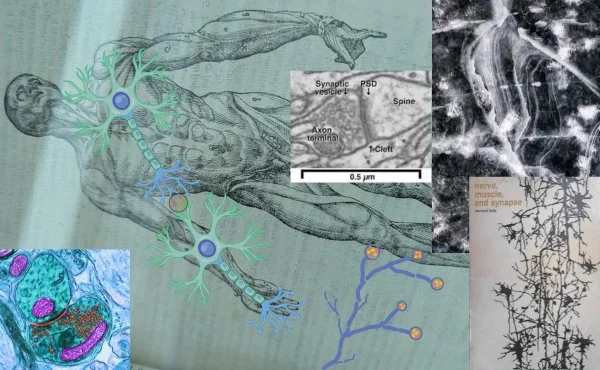
My moodboard for Pulse of Protection. Early visual research exploring cellular structures, synapses, and biological systems.
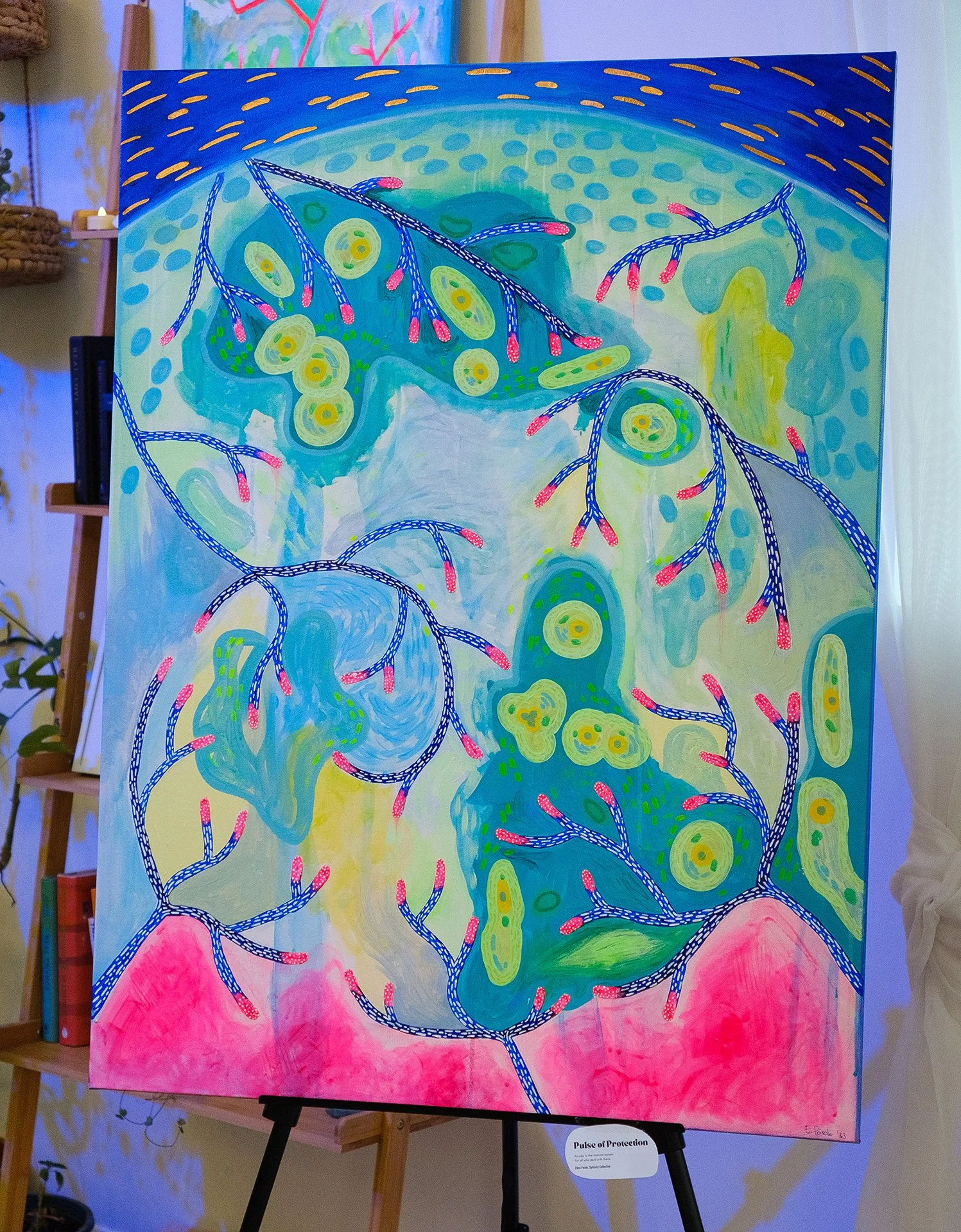
Painting: Elina Pasok. Pulse of Protection. Solo exhibition at The Space, London, March 2025.
Acrylic and copper foil on canvas. Developed through research into immune systems, cellular structures, and the body’s internal resilience.
Size: 101×76 cm
The visible work rests on invisible structure.
This pattern exists across all creative disciplines. When I visited Olafur Eliasson’s exhibition at Tate Modern, the most striking room was not the finished installations, but the room of process: crumpled sketches, prototypes, engineering correspondence, material experiments.
Behind every seamless experience was an intricate system. Turns out, creativity is not chaos. It is supported exploration.
I explored this relationship between structure, perception, and meaning further in my essay Duck Theory, where I describe how creative work evolves through different levels of abstraction.
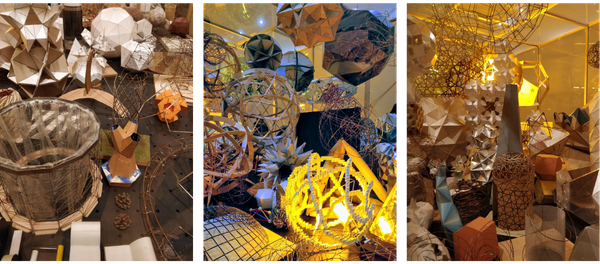
Olafur Eliasson process objects at Tate Modern, 2019. Behind every finished work lies a system of experiments, sketches, and structural thinking.
The Brain Was Never Meant to Hold Everything
For many years, I believed that remembering everything was part of being responsible. That keeping tasks in my head demonstrated competence. In reality, it was exhausting me.
Cognitive science now confirms what many creatives intuitively discover: the brain is designed for generating ideas, not storing logistical details. Psychologists call this cognitive offloading — transferring information from internal memory to external systems.
Writing things down frees mental bandwidth.
Small thoughts displace big thoughts.
Today, I maintain both analogue and digital systems. I still use notebooks — checklists for daily menial tasks, sketchbooks for ideas, diaries for moments I want to preserve. But I also rely heavily on structured calendars. I’ve given up battling with my brain as my default is “out of sight - out of mind“, and that’s not the best strategy.
I use a separate task calendar, colour-coded in purple. Every actionable task lives there. When it’s completed, I delete it from the calendar. When the day ends and the purple entries are gone, I know it’s a productive day.
This external structure allows my internal world to remain spacious. There is a psychological relief in knowing nothing important can be lost. When tasks are safely held outside the mind, the nervous system relaxes. Creativity becomes less fragile.
I don’t need to remember everything. I need to know where everything lives.
Structure Protects Creative Freedom
One of the most common misconceptions about structure is that it restricts creativity. In reality, it protects it.
When creative time is deliberately scheduled, it becomes real. It becomes inhabitable.
For two years, I had access to a private painting studio. The environment itself became part of the system. The materials were ready. The lighting was familiar. The transition into creative work required no friction.
All I had to do was arrive, make tea, choose a soundtrack, and begin.
At home, the boundaries are softer. The temptation to switch between roles — photographer, editor, administrator — is constant. Without structure, creative work sometimes dissolves into maintenance.
Protecting creative space is not indulgence. It became my infrastructure.
Research into brain function reveals that creativity emerges from a dynamic balance between focused attention and open, associative thinking. The brain’s Default Mode Network — responsible for imagination and insight — becomes most active when it is not overloaded by competing demands.
Structure reduces cognitive noise. Clarity invites creativity.
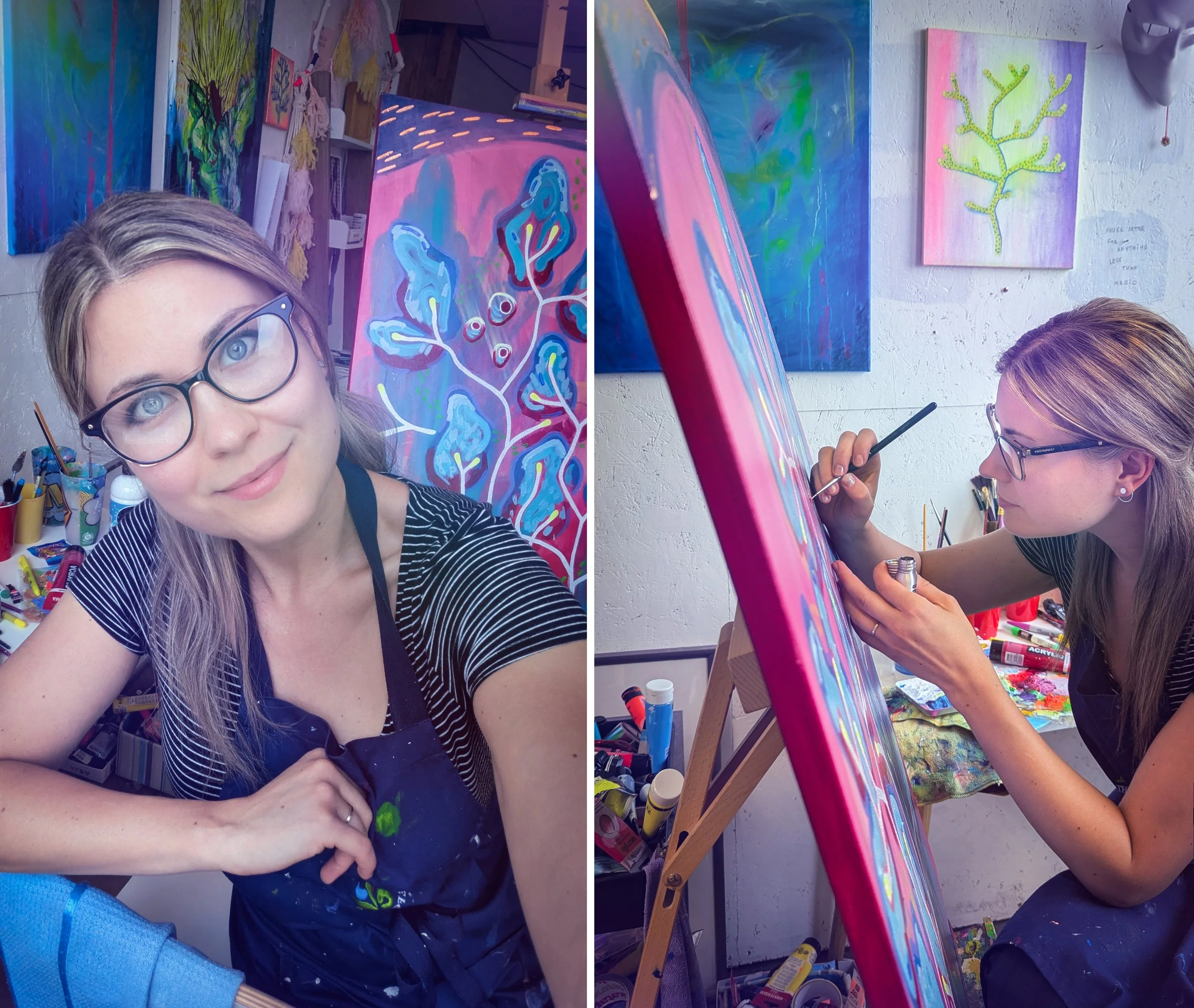
Working at the studio. Connect on my art instagram.
Understanding Your Internal Systems
Not all creative blocks are conceptual. Many are physiological.
Maslow’s hierarchy of needs, often represented abstractly, applies directly to daily experience. When basic needs — rest, nutrition, safety — are unmet, higher-order thinking becomes fragile.
What appears to be creative paralysis may simply be exhaustion. Here’s a gentle nudge to drink some water.
Decision fatigue, a well-documented psychological phenomenon, reduces cognitive flexibility. The brain becomes less capable of evaluating options, less tolerant of ambiguity.
Sometimes the most productive action is not pushing forward, but stepping back.
Eat. Rest. Reset.
Creative resilience depends on biological resilience.
Teaching Creativity Has Made This Clear
In the workshops I lead, I often encounter people who believe creativity belongs to others. IT- specialists, analysts, managers — people whose professional lives are quite structured and precise.
When given permission to explore ambiguity with games and tasks athat I offer, something shifts.
They begin very cautiously, creating in their usual patterns. Then playfully - inviting curiosity. Then fully.
At the same time, highly creative participants often arrive with the opposite challenge: abundant ideas, but no systems to stabilise them. Both groups benefit from the same realisation.
Creativity is not a personality type. It is a cognitive mode supported by intentional systems.
The goal is not to imitate someone else’s structure, but to build one that aligns with your own patterns of attention.
We are all different cognitive ecosystems.
Defying the Stereotype
The stereotype of the chaotic creative persists because it romanticises struggle. It suggests that disorder is evidence of authenticity. But in my experience, the most generative creatives are not chaotic. They are attentive to their energy, their environment, their commitments.
They build systems not to control their creativity, but to protect it.
Calendars. Sketchbooks. Kanban boards. Rituals. Boundaries.
These are not constraints, they are scaffolding. They allow imagination to operate without interference. They ensure that ideas do not remain abstract, but become real.
Reliability is not the opposite of creativity. It is the condition that allows creative work to be trusted, commissioned, and sustained over time.
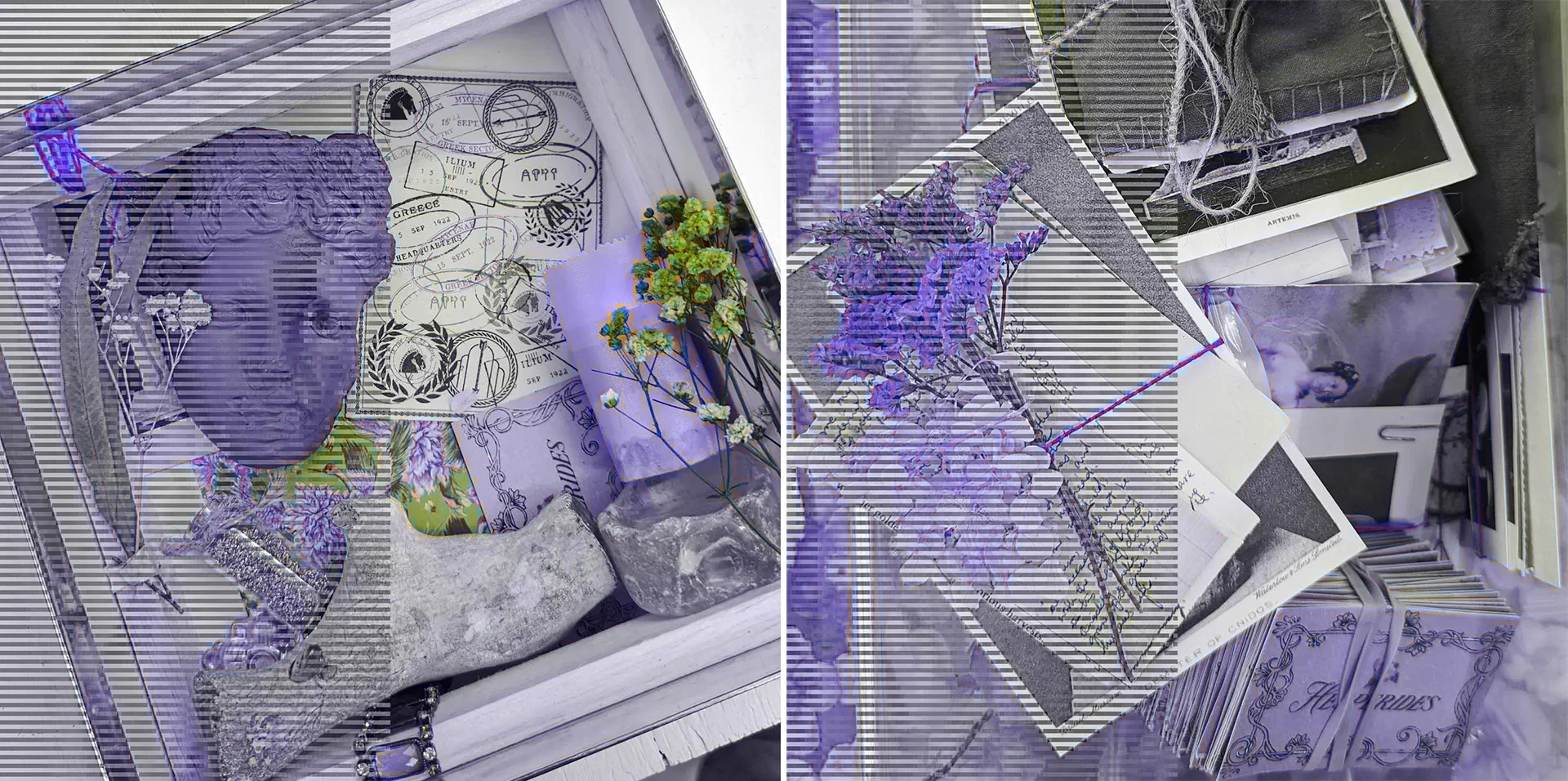
Process and research for a Inside the City: Design Workshop with Punchdrunk.
Final Thought
Creativity is not something that descends upon us. It is something we make space for.
Creativity lives in attention to ourselves.
Not every system needs to look the same. What matters is that it supports you. That it reduces friction between imagination and action. If you are creative, you do not need to become (even) more chaotic, maybe you need to become more attentive.
To yourself.
To your environment.
To the systems that allow your ideas to live.
Creativity is not chaos.
It is care.
Key Takeaways:
Creativity Is a System, Not a Personality Trait
Creativity thrives on structure, not chaos
Imagination generates ideas, but executive function - planning, organising, and following through - allows those ideas to exist in the world. The goal is not to control creativity. The goal is to make sure it has somewhere to live.
Your brain is designed to create, not to store logistics
Writing things down and using external systems frees cognitive bandwidth.
Small thoughts displace big thoughts.
Structure protects creative freedom
Scheduling creative time, reducing friction, and preparing environments in advance makes it easier to enter deep, focused states of work.
Creative blocks are often system failures, not talent failures
Fatigue, decision overload, and unclear priorities can interrupt creative flow. Supporting your physiological and cognitive needs restores clarity.
There is no universal system - only the one that works for you
The goal is not to replicate someone else’s process, but to build structures that align with your own patterns of attention and energy.
Creativity is sustained through attention
The most reliable creatives are not those with the most ideas, but those who create environments where ideas can survive, evolve, and become real.
Pay attention to what supports you.
Your creativity has always been waiting for a place to land.
Related articles:
Duck Theory: How Levels of Abstraction Shape Photography and Meaning
Elina Pasok is a London-based creative director, photographer, and artist. Her work explores creativity, perception, and the systems that allow ideas to become real. She leads workshops on creative thinking and visual communication.
